
Medical imaging color scales, frequently referred to as DICOM Colormaps or Look-Up Tables (LUTs), have become indispensable analytical features in modern healthcare. When we think of conventional radiology, the very first image that comes to mind is a rigid spectrum of black and white. For well over a century, grayscale has been the undisputed gold standard for reading X-Rays, CT scans, and MRIs across the globe.
However, the human eye has very real biological limitations. While a trained specialist might distinguish around 70 to 90 shades of gray under ideal lighting conditions, the human visual system can actually differentiate millions of distinct color variations. As medical software technology rapidly evolves, restricting diagnostic reviews strictly to grayscale means leaving incredibly valuable visual data completely unnoticed.
This is precisely where False-Color Scales become a critical clinical tool. By mapping specific Hounsfield Units (HU) or voxel intensities to vibrant color spectrums, radiologists can highlight extremely subtle anomalies that would otherwise blend completely into a dark background.
Here are the 5 ultimate secrets and clinical utilities of the most common medical imaging color scales used in a modern radiology workflow:
1. Grayscale: The Unshakable Foundation
Even when discussing advanced colorizations, Grayscale remains the primary standard for primary anatomical evaluation. Because it represents tissue density linearly and naturally (where dense bone at +1000 HU is bright white, air at -1000 HU is deep black, and soft tissues sit comfortably in the gray spectrum), it provides the most anatomically correct representation of the human body. Doctors will always use grayscale to understand the foundational structure before switching to specialized color analysis.
2. Black-Body Radiation (Hot Iron)
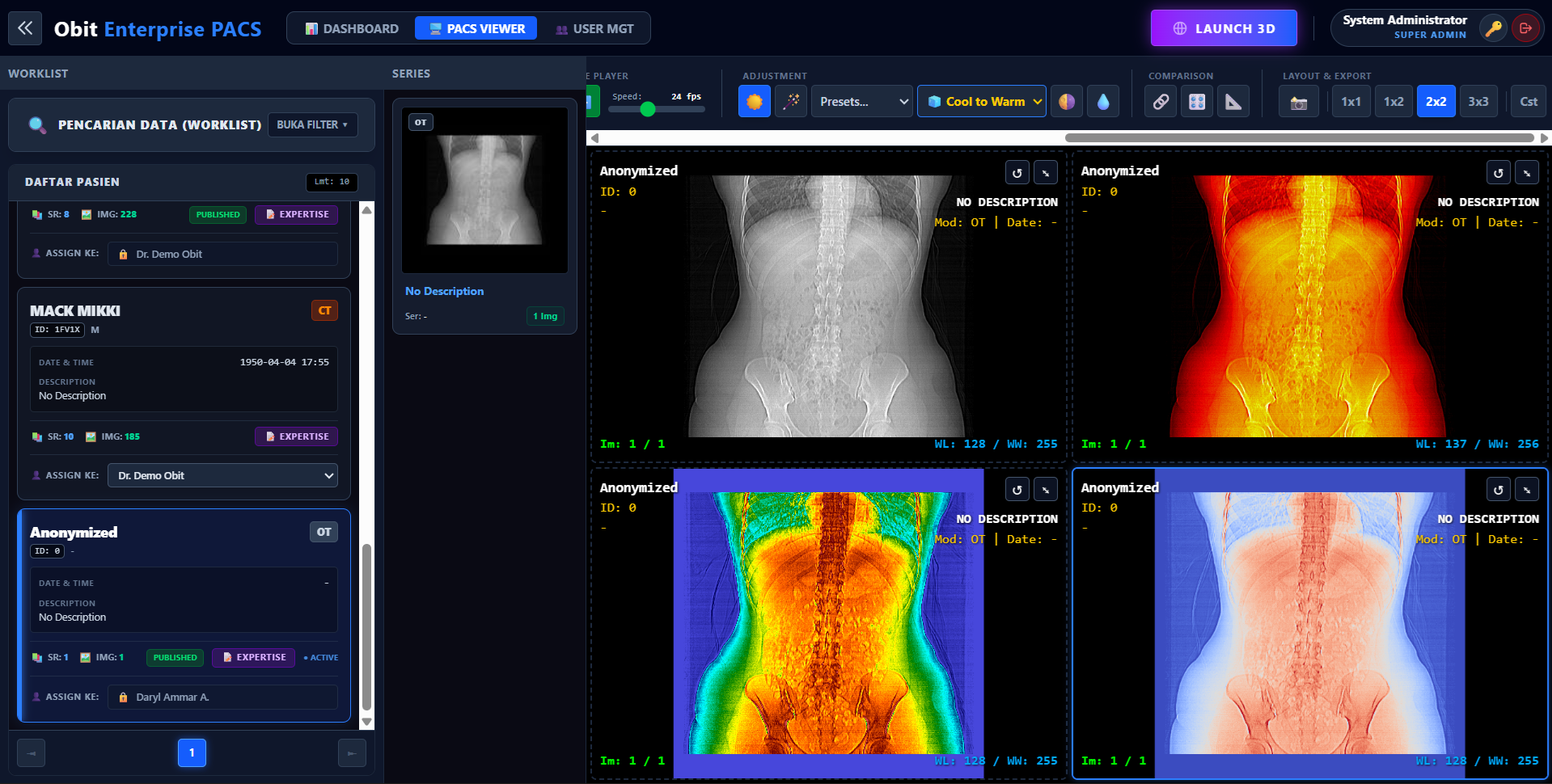
The "Hot Iron" scale transitions dramatically from deep black through red, orange, yellow, and finally blinding white. It perfectly mimics the visual spectrum of a heated metal object inside a forge. Clinically, this colormap is absolutely phenomenal for visualizing functional imaging, such as PET scans or Nuclear Medicine. It instantly draws the human eye to "hotspots"—areas of exceptionally high metabolic activity or contrast uptake, making it a critical tracking tool in oncology for tumor detection.
3. Rainbow (Desaturated)
The Rainbow scale utilizes the entire visible spectrum (blue, green, yellow, red). This dynamic filter is incredibly useful when visualizing complex 3D reconstructed volumes or mapping slight variations in tissue density. By assigning vastly different colors to tissue densities that are numerically very close, doctors can clearly delineate boundaries between different soft tissue masses. It is also the absolute standard in color Doppler ultrasounds to track the velocity and direction of blood flow in real-time.
4. Bone (X-Ray / CT)
The Bone colormap is a sepia-toned or bluish-white scale designed specifically to enhance the visibility of calcified structures. It intelligently increases the contrast at the absolute highest end of the density spectrum. As a result, micro-fractures, metastatic bone lesions, and skeletal anomalies "pop" against the surrounding soft tissue much more effectively than standard grayscale, ensuring no orthopedic detail goes unnoticed.
5. The Flexibility of Medical Imaging Color Scales in Web-Based PACS
In the past, applying these complex color filters required powerful dedicated workstations and significant rendering time. However, with the advent of Web-Based PACS architectures, radiologists can now manipulate medical imaging color scales in real-time directly within their standard web browsers. This zero-footprint flexibility allows doctors to rapidly cycle from Grayscale to Hot Iron to Bone with a single click, drastically reducing turnaround times in emergency clinical scenarios.
Elevating the Hospital Diagnostic Experience
Understanding exactly when to apply the right colormap transforms a standard review into a highly precise diagnostic session. At Obit Enterprise, we have engineered our zero-footprint viewer to include instant, fluid transitions between these essential medical imaging color scales. Ensure your healthcare facility is equipped with the ultimate tools to deliver the highest standard of patient care.